


Climbing the world’s fourth highest peak: a humbling journey
- Winter Hawk
- Nov 26, 2022
- 5 min read

I spent the month of May in Tanzania. This is the story of my trek up Mount Kilimanjaro.
October 2022
Stepping onto the tarmac of the international airport on Zanzibar Island, Tanzania, I was stifled for a minute by the hot, thick East African air. Beads of sweat started to trickle down from my hairline as I shuffled into the cramped airport to retrieve my duffle bag.
I flew to Tanzania for an international volunteer program called Growth International Volunteer Excursions (GIVE). The program housed us on Zanzibar Island, just off the east coast of mainland Tanzania, for two weeks before flying us to the mainland for a two-day safari.
While the trip ended shortly thereafter for other volunteers, it marked the beginning of a new journey for me. I met my mother, sister and step-brother in the capital of Tanzania, Dar es Salaam, for what came to be the most humbling, exhausting and exhilarating journey of my life – so far.
Our two-week excursion began in mid-May with a short flight from the capital to Arusha, a northern region bordering Kenya. Arusha is the gateway to Tanzania’s highest peak, Mount Kilimanjaro.

A snow-capped Mount Kilimanjaro. This image was taken on the Marangu Route two days before summit day.
Towering over Tanzania at 19,340 feet above sea level, the snow-capped roof of Africa is also the highest free-standing mountain in the world and the fourth highest peak of the Seven Summits – a series of the highest mountaintops from each continent.
My family and I piled into a van in Arusha with 12 porters – three porters each, who transported our bags of thermal clothes and food – along with a lead guide, his nephew who was our assistant guide and a chef they called a "stomach engineer."
We drove from Arusha to the base of Kilimanjaro National Park, where the air was crisp and thin from the heightened altitude. Ascending the Marangu route, we began our five-day trek.
I wound my hiking boots as tight as comfortably possible, meanwhile our experienced lead guide, Josiah Mollel – who we called Babaluu, a nickname combining the word father in Swahili, Baba, and the name of the fictional bear Baloo from the Jungle Book – fastened his Croc clogs with the adjustable strap holding his heel in place.
It was a routine trip for Babaluu, who had already summited the mountain's peak over 760 times. He planned to retire after his 1000th summit, leaving the guide business to his nephew, Frank Penetie.

Winding our way through the lush, emerald-green rainforest, my family and I marveled at the eerily mystical moss hanging from the aged trees. Stones and bulging tree roots served as stairs as we marched for three hours to the Mahdara Hut, where we fueled up with vegetables and soup and rested our first night.
The next day, we trekked for five more hours to the Horombo Hut. Our path through the sloping countryside was hemmed with dense bushes and vast grassland. The ground, however, soon lost its signs of life as we slid into tundra-like terrain where only a few trees grew and fewer flowers blossomed.
The rainforest we trekked through our first day on the Marangu Route.
We slept that night above the plush cloud line with heating pads full of boiling water stuffed in our sleeping bags. But in the morning, as the sun lined the edge of the clouds, my stomach began to churn.
The food I’d tried so hard to keep down so I could maintain the strength to trudge on was not interested in staying put. I felt weak the day before but chalked it up to the hours-long parade through hillsides. But this time, I coughed up all I had eaten, and three days in, I couldn’t easily turn around without my family.
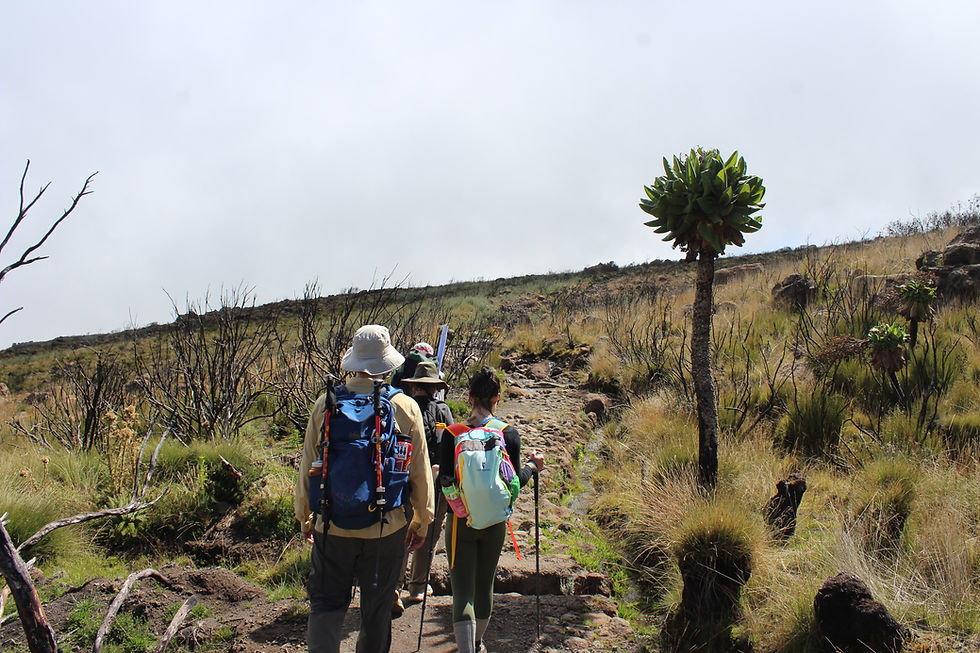
Hiking sticks in hand, we trudged through tundra-like terrain on our second day ascending the Marangu Route.
I lumbered on for five more hours to the base camp, Kibo Hut, at the bottom of the mountain. Once settled in, I walked to the dining hall with my sister for an earlier-than-usual dinner. Our heads tilted back as we scanned the mountain for walking paths we couldn’t find; we stood perplexed at how we’d surmount something so steep.
We ate dinner around five o’clock so that we'd have enough time to sleep before waking up just before midnight to begin our hike to the summit. Starting the summit day hike in the middle of the night is routine; it ensures climbers can summit at sunrise and still have the rest of the day to trek down the mountain, and for some, back to the entrance gate.
The night was pitch-black aside from the shine of the stars above us and the fluorescent headlamps strapped to our foreheads. I wiggled my toes in my wool socks every couple of minutes to make sure I could still feel them. Soon, my feet felt like bricks of ice, and I grew frustrated over losing an inch of every step I took as I slid down the sheer dirt and rocky soil.
With one porter, now called a summit guide, for each of us, we snaked our way up the mountain. Not long after, likely an hour into the climb, the breaks for water became more frequent as I struggled to see. The dark of the night, only shortly lit from the skyline resting below us in Kenya, was becoming darker in patches.
I looked up at the outline of the rest of the peak, where distant headlamps appeared as mere freckles on the mountain’s face. My heart sank because I knew that if I continued, I’d faint.
I was forced to swallow the hardest pill of my life and turn around, leaving my 63-year-old mother, sobbing sister and altitude-sick step-brother on the mountain.

A view of Mount Kilimanjaro from the Kibo Hut base camp.
I glided down the mountain at a pace that couldn’t slow because of the incline. Tears streamed down my face as my summit guide tightly clasped my hand and led me back to the base camp. I was shriveled in my sleeping bag when another porter tiptoed into the hut, calling me “dada” or sister in Swahili, and asking if I was all right.
When I woke up, no one was back yet. I set up at the base of the mountain to welcome my family as they descended. Sitting on a bucket, my back was pressed against a sign warning climbers of the dangers of altitude sickness and advising them to descend the mountain rather than putting themselves at risk.
Trickling in, one by one, my step-brother, sister and finally my mother returned safely. Stripped of their layers and sweating, we embraced each other as if they had come home from war. This trek was a war of the heart and mind. It humbled us all after we each experienced a version of looking forward into darkness while leaving family behind.
At times, we were all apart from one another. Our porters became our saviors or best friends, or both. But at the top, my loved ones cried together as they were unexpectedly reunited – my mother on her way to the summit peak and my siblings on their way back.
“Pole pole” was the phrase we were taught before embarking on this journey. Translating to “slowly,” our guides showed us how the climb was a journey to be taken in moderation, step by step.
Subscribe to stay updated!


Comments